


Governance Structure
A multi-academy trust (MAT) is a group of aligned educational academies that come together to form a trust. Academies in the UK school system are educational institutions that rely on state funding directly from the Department for Education (DfE). When they join a trust, funding is shared between the schools under an Academy Funding Agreement.
Independent of their local authority, MATs and their members essentially become a charity with a single board of trustees to oversee all decision-making. All staff within MAT schools are also employed by the company, forming a conglomerate-type arrangement.
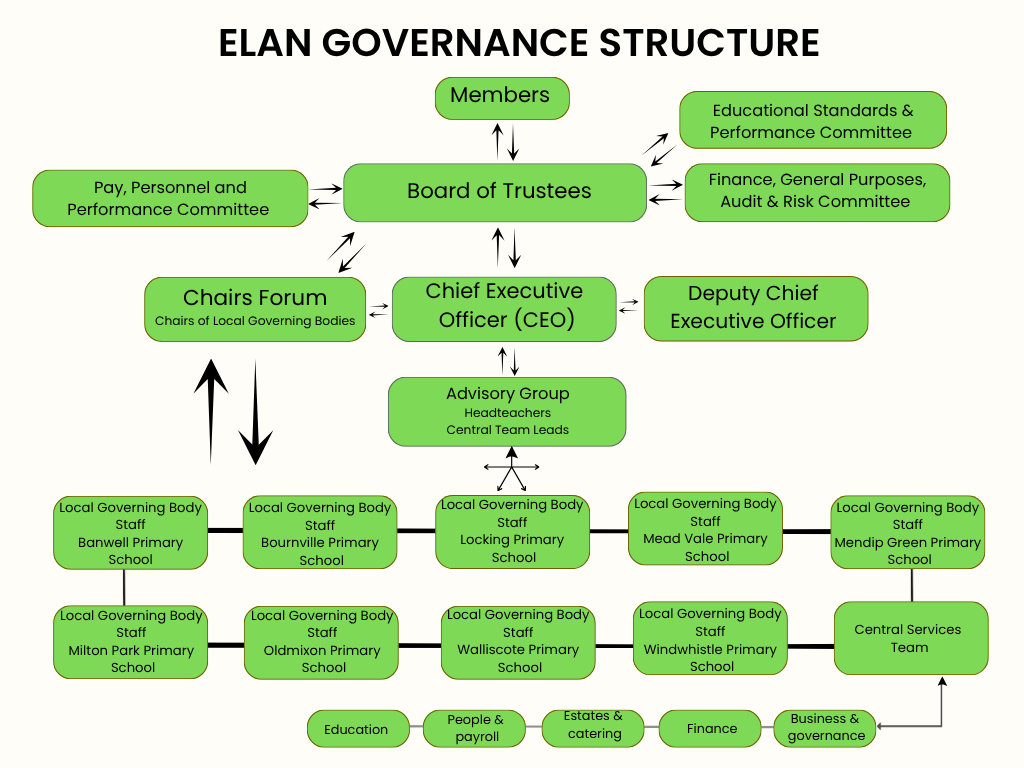
Members
ELAN members play a vital role in fulfilling the requirements of company law, such as receiving accounts, appointing new members, and updating the memorandum. They are responsible for assessing the performance of the board of trustees to ensure the trust’s purpose and charitable objectives are being met. Each member contributes valuable knowledge and expertise from their area of practice, offering practical guidance where appropriate. Members hold and attend an annual general meeting (AGM) once a year.
Board of Trustees
The ELAN board of trustees holds overall responsibility and final decision-making authority for all trust activities. Trustees oversee educational standards, performance, and finances across all academies within the trust, ensuring compliance with government guidelines on safeguarding, equality, and diversity. The board also determines which responsibilities to delegate to local governing bodies through the scheme of delegation.
MAT Sub-committees
To support its work, the board may establish MAT sub-committees as needed. These committees are primarily made up of trustees, with additional members invited based on their relevant skills and expertise.
Local Governing Bodies
Each school within the Extend Learning Academies Network (ELAN) has a Local Governing Body (LGB) with clearly defined delegated responsibilities. LGBs play a key role in providing local governance and accountability, offering insights that help trustees carry out their duties effectively. Their remit includes:
- Monitoring the school’s educational standards and performance.
- Supporting and constructively challenging the headteacher.
- Overseeing the school’s financial performance to ensure funds are used effectively, in line with the scheme of delegation.

